



[ad_1]
On a nationwide range, the USA as well as Canada count on a really various make-up of resources to produce their power.
The united state mostly makes use of gas, coal, as well as nuclear power, while Canada relies upon both hydro as well as nuclear. That claimed, when focusing on the district or state degree, private key power resources can vary significantly.
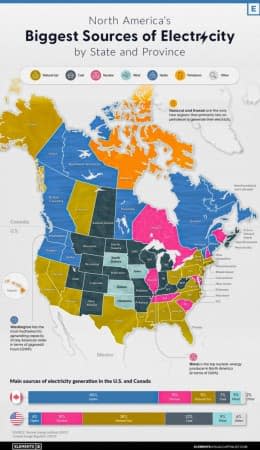
In the infographic listed below, Visual Capitalist’s Selin O?uz has a look at the power generation in the states as well as districts of these 2 nations making use of information from the Nuclear Energy Institute ( 2021) as well as the Canada Energy Regulator ( 2019 ).
All-natural Gas
Natural gas is commonly utilized for power generation in the USA. Called a “cleaner” nonrenewable fuel source, its wealth, paired with a well established nationwide circulation network as well as fairly affordable, makes it the leading power resource in the nation.
In 2021, 38% of the 4120 terawatt-hours (TWh) of power created in the united state originated from gas. Not remarkably, greater than 40% of American states have gas as their most significant power resource.
Right here are some states that have the biggest shares of all-natural gas-sourced power.

In Canada, gas is just the third-biggest power resource (behind hydro as well as nuclear), audit for 11% of the 632 TWh of power generated in 2019. Alberta is the only district with gas as its major resource of power.
Nuclear
Nuclear power is a carbon-free power resource that composes a significant share of the power created in both the united state as well as Canada.
19% of America’s as well as 15% of Canada’s power originates from nuclear power. While the portions are close to each other, it’s great to keep in mind that the USA produces 6 to 7 times much more power than Canada annually, producing a great deal much more nuclear power than Canada in regards to gigawatt hrs (GWh) annually.
Related: Chevron Sold Venezuelan Oil To Phillips 66
As seen in the map, several states as well as districts with nuclear as their major resource of power are focused in the eastern fifty percent of both nations.
In the united state, Illinois, Pennsylvania, as well as South Carolina are leading manufacturers in regards to GWh/year. Illinois as well as South Carolina likewise have nuclear as their key power resource, whereas Pennsylvania’s power manufacturing from gas surpasses that from nuclear.
The huge bulk of Canada’s atomic power plants (18 of 19) remain in Ontario, with the 19th in New Brunswick. Both of these districts count on nuclear as their most significant resource of power.
Renewables: Hydro, Wind as well as Solar
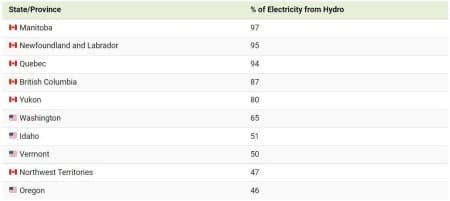
Out of the various sorts of sustainable power resources, hydro is one of the most widespread in The United States and Canada. As an example, 60% of Canada’s as well as 6% of the united state’s power originates from hydropower.
Right here are the states as well as districts that have hydro as their most significant resource of power.
Wind as well as solar energy jointly make up a little percent of overall power created in both nations. While no state or district relies upon solar as its most significant resource of power, Iowa, Kansas, Oklahoma, as well as South Dakota depend mostly on wind for their power, in addition to Canada’s Royal prince Edward Island (PEI).
Coal as well as Oil
Coal as well as oil are emission-heavy power resources still widespread in The United States and Canada.
Currently, 22% of America’s as well as 7% of Canada’s power originates from coal, with locations such as Kentucky, Missouri, West Virginia, Saskatchewan, as well as Nova Scotia still depending on coal as their most significant resources of power.
Specific areas likewise utilize oil to produce their power. Although its usage for this objective is decreasing, it is still the most significant resource of power in both Hawaii as well as Nunavut.
Over the following couple of years, it will certainly interest observe using these nonrenewable fuel sources for power generation in the united state as well as Canada. Regardless of the distinctions in climate commitments in between both nations, reducing coal as well as oil-related discharges might be a vital component of striking decarbonization targets in a prompt fashion.
By Zerohedge.com
More Leading Reads From Oilprice.com:
.