



[ad_1]
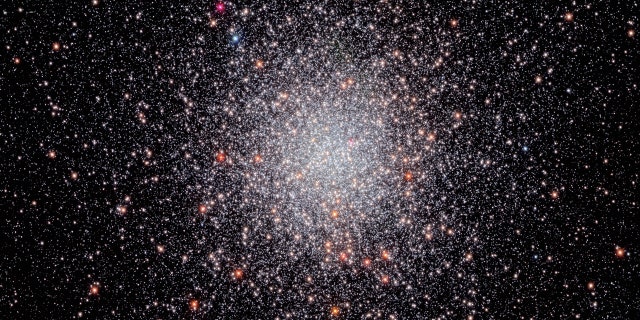
The Hubble Space Telescope just recently caught the “shining throng” of celebrities of the globular collection NGC 6440.
The collection lies in the constellation Sagittarius, some 28,000 light-years away.
Globular collections like NGC 6440 are tightly-packed collections of celebrities that survive on the sides of galaxies.
They can hold anywhere from numerous thousands to countless celebrities that balance regarding one light-year apart.
2022 SPACE STORIES THAT ARE OUT OF THIS WORLD
However, they can be as close with each other as the dimension of our planetary system.
.
Appearing like a flashing throng of humming , the celebrities of globular collection NGC 6440 beam vibrantly in this NASA Hubble Space Telescope photo. The collection is found some 28,000 light-years away in the constellation Sagittarius, the Archer.
( Image credit report: NASA, ESA, C. Pallanca as well as F. Ferraro (Universits Di Bologna), as well as M. van Kerkwijk (University of Toronto); Processing: G. Kober (NASA/Catholic University of America))
NASA said the data used to produce the photo originated from 5 various Hubble observing programs.
HUBBLE IMAGES SHOW STARS IN GLOBULAR CLUSTER GLEAMING WITH ‘NEBULOSITY’

.
An astronaut aboard the space capsule Atlantis caught this picture of the Hubble Space Telescope on May 19, 2009.
( NASA)
Four of those programs concentrated on the residential or commercial properties of pulsars, which are extremely allured, turning neutron celebrities that give off a beam of light of electro-magnetic radiation from their magnetic posts.
NGC 6440 was discovered in the 18th century by astronomer William Herschel.
.
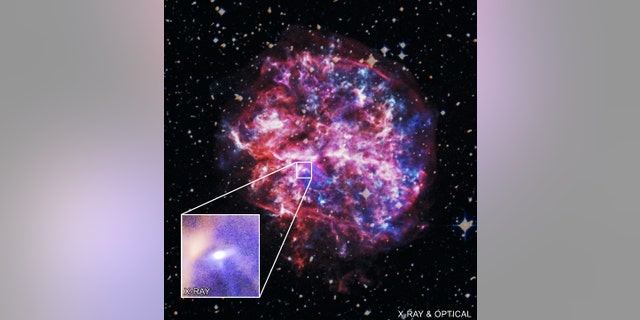
A young pulsar is blazing via the Milky Way at a rate of over a million miles per hr. This excellent speedster, experienced by NASA’s Chandra X-ray Observatory, is among the fastest things of its kind ever before seen..
( Image credit report: X-ray: NASA/CXC/SAO/ L. Xi et al.; Optical: Palomar DSS2)
CLICK HERE TO GET THE FOX NEWS APP
According to Space.com, it is the residence to at the very least 8 of the rapidly rotating pulsars.
.